
Walk into most Singapore SME offices and “group medical” means something practical: staff can see a doctor without draining cash, and a hospital bill will not swamp the company or the employee overnight. The thinking is rarely about product brands first. It is about headcount mix, cash flow, talent retention, and not being the firm that underinsured a foreign worker against a Ministry of Manpower (MOM) minimum. This briefing is informational. It is not advice to buy any plan; check current MOM, Ministry of Health (MOH), and CPF Board pages before you lock numbers.
What SMEs usually mean by group medical
In practice, the phrase covers a master policy the employer owns. Eligible employees sit under that schedule while they are employed. Typical building blocks are Group Hospital & Surgical (GHS) for inpatient and day surgery, plus an outpatient layer for GP and specialist visits. Some firms add dental, maternity, or major medical riders later. Public explainers of group medical coverage basics often start from that same stack because the vocabulary on quotes matches how HR and finance talk about benefits.
For Singapore citizens and permanent residents, national cover already exists. MediShield Life, administered via the CPF Board for MOH, helps with large hospital bills and selected costly outpatient treatments, sized mainly for subsidised B2/C-class care. Company plans sit beside that baseline, not instead of it.
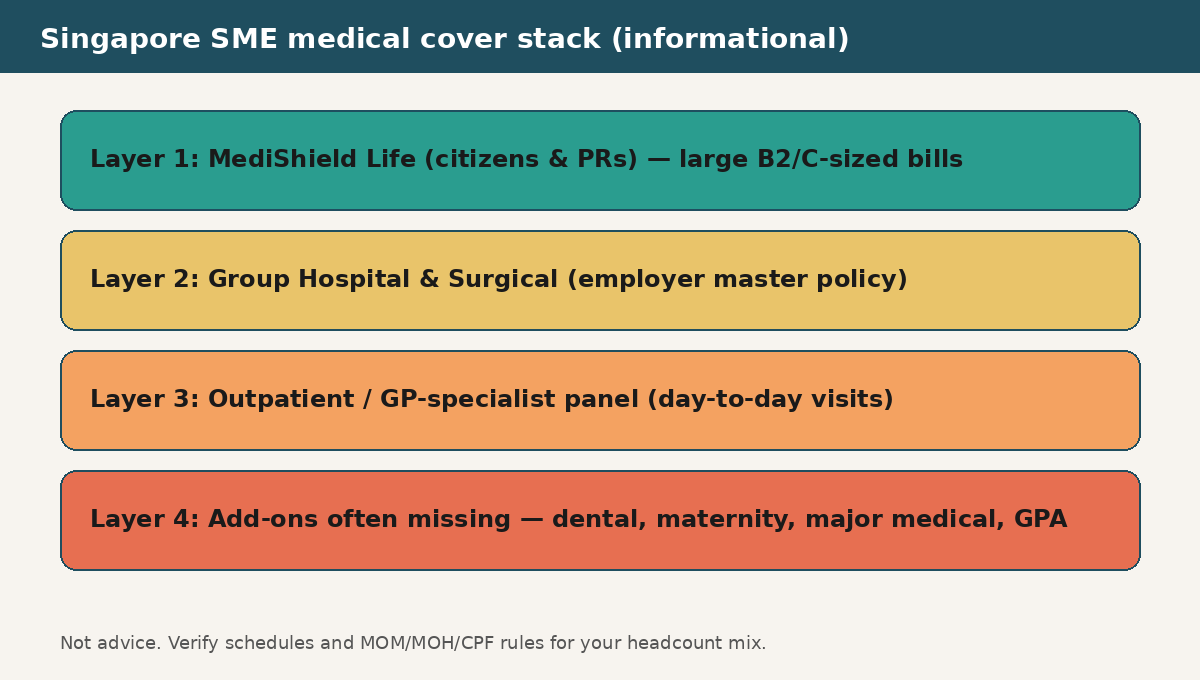
Coverage basics that show up on most schedules
Quotes usually force a few concrete choices. Ward class or room-and-board entitlement sets expectations about public versus private hospitals. Surgical benefits may follow a schedule of fixed amounts or an “as charged” style up to an annual limit. Outpatient plans lean on panel clinics, co-payments, and referral rules for specialists. Annual aggregate limits and per-disability caps decide how far one expensive year can go.
SMEs also budget soft costs: e-card admin, claim speed, and whether dependants are included. Conversations about how SMEs budget employment benefits often turn less on brochure features and more on whether outpatient visits feel usable week to week.
Educational overview of MediShield Life and Integrated Shield Plan changes. Useful context for how company medical sits beside national cover; confirm current MOH and CPF rules separately.
Rules and incentives that reshape the brief
Two government tracks change how owners and HR frame the purchase. First, foreign-worker medical insurance is not optional for S Pass and Work Permit holders. MOM requires employer-funded inpatient and day-surgery cover at a stated annual minimum (currently at least S$60,000 per worker under the enhanced regime), with co-payment and exclusion rules that have been tightening in stages. Details sit on the MOM S Pass medical insurance page; many SMEs keep that policy line separate from the local-staff GHS schedule so minimums are never blurred.
Second, for local employees, medical benefits are largely a talent and tax design problem rather than a hard mandate. MOM’s portable medical benefits schemes (PMBS, TMIS, or providing a Shield plan) can raise the medical-expense tax deduction cap from 1% to 2% of remuneration when qualifying conditions are met. The official outline is on MOM’s portable medical benefits page. CPF and IRAS pages fill in MediSave contribution and deduction mechanics. Those levers matter when finance asks whether a richer outpatient panel is “just cost” or part of a deductible benefits architecture.
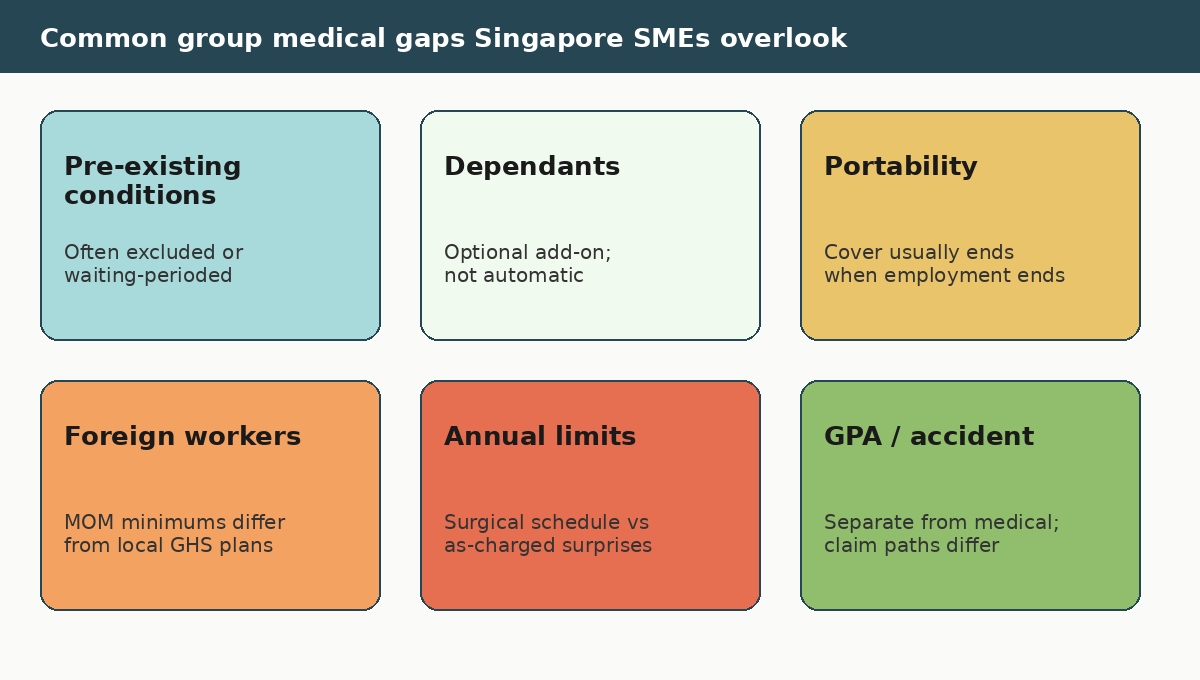
Common gaps that surface after the first claim
Pre-existing conditions are the classic surprise. Many group schedules exclude them or apply waiting periods; MediShield Life’s national design is different, so staff can wrongly assume “company medical” inherits that generosity. Dependants are another: spouses and children are often optional, not automatic. Portability is weak for ordinary GHS; cover usually ends when employment ends unless the firm deliberately uses a transferable design such as TMIS.
Annual limits and surgical schedules create a second class of shock when a private hospital bill outruns the table. Panel clinic lists that look wide on day one shrink when preferred clinics leave the network. Maternity waiting periods disappoint teams hiring young parents mid-year. Accident pathways are easy to confuse with medical: a fracture may sit under GHS, under workers’ compensation rules, or under a separate group personal accident cover, depending on cause and policy wording. Treating those as one bucket is how SMEs under-document claims.
A quieter review habit for the next quarter
Before renewing, map three columns on one page: local staff GHS and outpatient; foreign-worker MOM-minimum medical; and accident or WICA-related lines. Mark what ends when someone resigns, what waits for pre-existing conditions, and who owns dependant enrolment. Then ask one plain question in the management meeting: which gap would embarrass us most if a claim arrived next month, and is that a benefits design issue or an HR communication issue?
That is usually enough to turn “we should get group medical” into a checklist owners can defend.